When Repair Is the Right Call
Most AC calls we get in Kissimmee are for one failed part, not a failed system. A weak capacitor, a burnt contactor, a worn fan motor, a clogged drain line or a loose wire can stop an AC completely, and each is a normal repair.
- The system is under about 10 years old.
- It uses R-410A refrigerant (most systems installed after 2010).
- The problem is one part, and the rest of the system tests healthy.
- It has cooled the house well until now, and your power bills haven't jumped.
When Replacement Makes More Sense
- Age: in Central Florida an AC runs most of the year, so 12 to 15 years is a typical life span. Past that, one repair is often followed by another.
- R-22 refrigerant: systems from before 2010 often use R-22, which hasn't been made in the US since 2020. If an R-22 system is leaking, recharging it is expensive and only buys time.
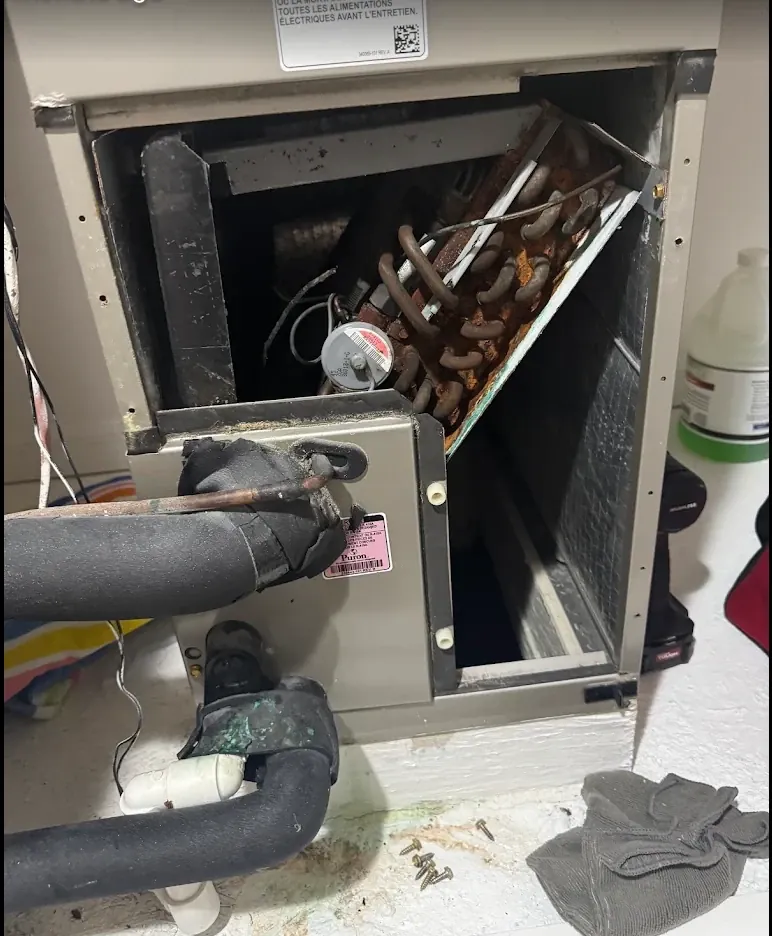
- Compressor or coil failure on an older system: these are the most expensive parts, and the cost can approach a new system.
- The 50% rule: if a repair costs about half of what a replacement would, replacement is usually the better use of the money.
- Repeated breakdowns, rising power bills or rooms that never get cool.
A Quick Rule of Thumb: the $5,000 Rule
Multiply the age of the system by the repair cost. If the result is more than 5,000, replacing usually makes more sense; if it's less, repair. For example, a 6-year-old system with a $300 repair gives 1,800, so repair it. It's only a guide, and we'll talk you through the details of your system.
What About Efficiency?
New systems in Florida must meet a federal minimum of 14.3 SEER2 for most central split systems. An older system can be much less efficient, so in our heat a new one can lower your power bill. New systems also use newer refrigerants such as R-454B or R-32, since the industry is moving away from R-410A for new equipment.
That said, saving on power alone rarely pays for a new system quickly. If your system is reliable and cooling well, there's no need to replace it just for efficiency.
How We Advise You
We test the system before we recommend anything, show you what failed and give you a flat-rate price for the repair. If we think replacement makes more sense, we tell you why, and the decision is yours. Some of our customer reviews are from people who were told by another company they needed a new system and only needed a repair.
If replacing is the right choice, see our AC installation page. If repair is, see AC repair.
Frequently Asked Questions
How long does an AC last in Florida?
Usually 12 to 15 years. Constant use, humidity and, near the coast, salt air shorten its life compared with cooler states. Yearly maintenance helps it reach the high end of that range.
Is it worth fixing a 15-year-old AC?
Sometimes. If it's a small, single-part repair and the rest of the system is healthy, a repair can make sense while you plan for a replacement. If it needs a compressor or a coil, or uses R-22, replacement is usually the better choice.
My AC uses R-22. Do I have to replace it?
Not right away. R-22 systems can still be repaired. But if the system is leaking refrigerant, recharging with R-22 is expensive, and replacement is usually the better long-term choice.
Will you try to sell me a new system?
No. We recommend a repair whenever a repair will do the job, and we explain what we found so you can decide.
How much does a diagnosis cost?
The quote is free when you hire us for the work. If you decide not to move forward, there's a $60 quote fee.